
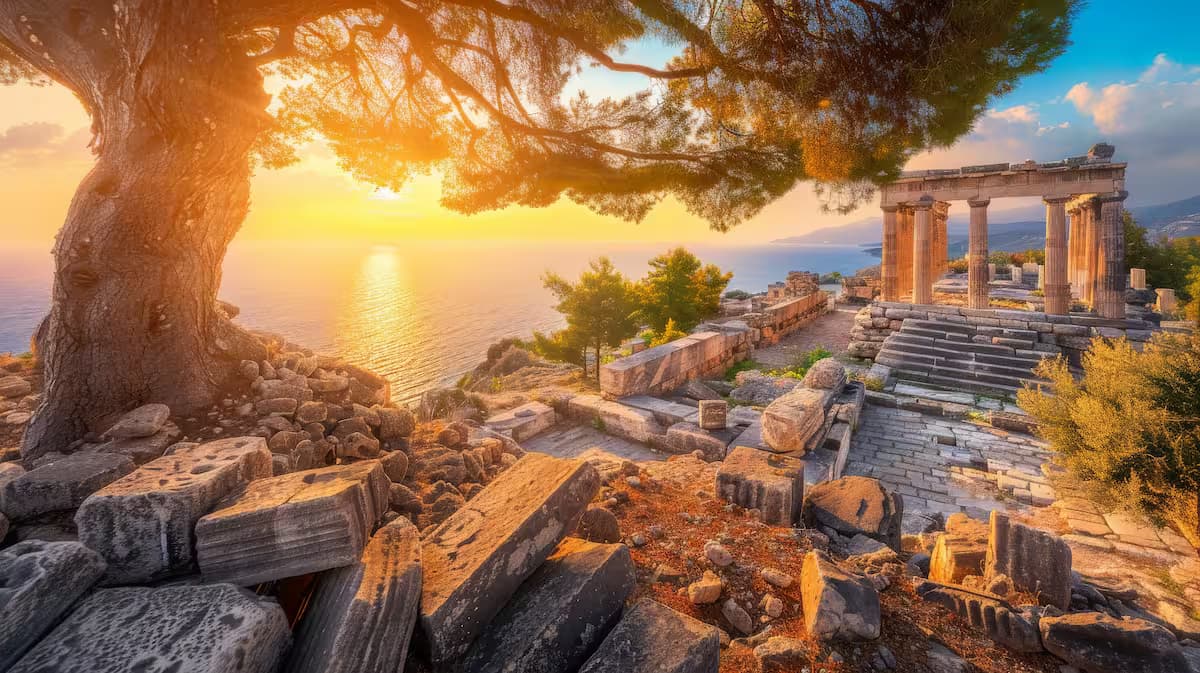
Greece has more coastline per square kilometre than almost any country in Europe, and most of it is reachable only by car. Crete alone stretches 260 kilometres from end to end; Rhodes, Corfu, Kefalonia, Zakynthos, Mykonos, and Santorini each conceal gorges, vineyards, Byzantine chapels, and empty lagoons that public buses reach once a day if at all. Car rental in Greece is not a convenience — for most itineraries, it is the single decision that separates a genuine experience of the country from being confined to the resort promenade.
Why Car Rental in Greece Changes Everything
Local Greek car rental partners price differently from international chains: lower daily rates, transparent extras, and staff who actually know the roads you are planning to drive. Pickup is available at the airport, the port, or your hotel door. The freedom is immediate — you leave when you want, reach beaches with no bus route, stop at a village bakery before it sells out, and return to your hotel at sunset without consulting a timetable. For family trips, group holidays, or anyone planning more than one destination in a fortnight, renting from a local partner is almost always the most cost-efficient and flexible choice.
What Every Driver Needs to Know Before Renting in Greece
The minimum rental age on most Greek islands is 21, and the driving licence must have been valid for at least 2 years — partners enforce both requirements strictly at pickup. Crete is the major exception: the minimum age there is 18, though some partners still require 21 for automatic or premium categories. Use the age filter on the search page to see only the cars available to you. EU and EEA licences are valid everywhere in Greece without additional documents. Drivers from the UK, USA, Australia, Canada, and other non-EU countries must carry an International Driving Permit alongside their national licence — most Greek partners ask to see both documents at handover. There are no toll roads on any Greek island, including Crete, Rhodes, and Corfu.
Island Pick-Up and Drop-Off: The Rule Nobody Mentions
On most Greek islands, the rental car must be returned to the same pick-up location — usually the island airport. Rental cars are not permitted on Greek ferries as passenger vehicles, so driving a rental from Mykonos to Paros or from Zakynthos to Kefalonia in a single booking is not possible. Plan each island as a self-contained car hire: fly in, rent, explore, return the car, fly out. Karpadu offers a wide variety of pick-up and drop-off options across the Greek islands — use the different drop-off location filter on the search page to check one-way car rental availability for your specific route. You may find more flexibility than you expect. Crete is the genuine exception: at 260 kilometres long, one-way car rentals between any two points on the island are standard. Picking up at Heraklion Airport (HER) and returning at Chania Airport (CHQ) — or the reverse — carries no surcharge in most cases, making a full island crossing the most rewarding way to explore Crete by car.
No Deposit Car Rental in Greece: How Premium Insurance Works
Standard car rental in Greece typically requires a credit card with a deposit blocked for the full rental period — amounts range from €300 to €1,500 depending on the car category and partner. Karpadu's Premium Insurance eliminates this entirely. Use the No Deposit filter on the search results page: it shows only vehicles where the partner waives the deposit completely — no amount is blocked on any card. Pay at pickup in cash, by debit card, or by prepaid card. Zero excess means zero deposit; if something happens to the car, the Premium Insurance covers it and you pay nothing for covered damage. Glass, tyres, mirrors and the undercarriage are the exception — as with most Greek rentals, they are not covered at any insurance level.
Crete: The Greatest Car Rental Journey in Greece
Crete rewards car rental more generously than any other Greek island. The north-coast VOAK highway between Heraklion and Chania is fast dual carriageway — 140 kilometres in under 90 minutes. From that spine, roads drop south to the Libyan Sea (Matala 75 km from Heraklion; Preveli Beach 47 km from Rethymno) or climb to the Samaria Gorge (43 km from Chania, the longest gorge hike in Europe at 16 km) and the Lassithi Plateau (50 km from Heraklion, 900 m altitude). Elafonissi — Greece's most famous pink-sand lagoon — is 73 kilometres from Chania (80–90 minutes). Knossos, the greatest Minoan palace, is 5 kilometres from Heraklion city centre, 15 minutes from HER airport. One-way rentals mean you can cross the island's full 260 kilometres without retracing a single road.
Rhodes: From Diagoras Airport to Lindos and the Far South
Rhodes — Greece's fourth-largest island — is one of its most rewarding to drive. Diagoras Airport (RHO) is 14 kilometres south-west of Rhodes Town; 20 minutes on the coastal road and you reach the UNESCO medieval Old Town, whose 4 kilometres of Crusader walls enclose a car-free labyrinth. Park at the D'Amboise Gate or Koskinou Gate. Lindos is 50 kilometres south of Rhodes Town — 55 to 65 minutes down the east coast past Anthony Quinn Bay (Vagies, 20 km from the airport), Tsambika Beach (48 km), and Kolymbia. The road continues 40 kilometres south of Lindos to Prasonisi, a narrow sand spit at the island's southern tip where the Aegean meets the Mediterranean — one of Europe's top windsurfing spots and among the least-visited corners of Greece. Minimum rental age on Rhodes is 21 with 2 years of licence validity. There are no toll roads anywhere on the island.
Corfu: Lush Drives Through the Green Ionian
Corfu is 60 kilometres long, green even in August, and one of the easiest islands to drive in Greece. Corfu International Airport (CFU) is 2 kilometres from Corfu Town — you can be on the road in under 30 minutes of landing. Paleokastritsa, the island's most photographed bay, is 26 kilometres west of Corfu Town (35 minutes on a winding mountain road). Kassiopi harbour in the north-east is 36 kilometres (40 minutes). Sidari and the Canal d'Amour sea rock formations in the north are 38 kilometres (45 minutes). Pelekas village and its hilltop sunset viewpoint are 15 kilometres west of Corfu Town. Unlike most Greek islands, Corfu has enough road network to loop the entire island in a single full day, taking in Venetian hill towns, olive groves, and north-coast cliffs that drop to electric-blue bays.
Zakynthos and Kefalonia: Ionian Drama on Four Wheels
Zakynthos and Kefalonia both require a car to see anything beyond the airport transfer route. Minimum rental age on both islands is 21 with 2 years of licence validity. On Zakynthos (ZTH), the famous Navagio Shipwreck Beach is visible only from the clifftop viewpoint reached by road — the beach itself is accessible by boat from Porto Vromi only. Gerakas turtle beach and the Keri cave sea arches are both within 30 minutes of ZTH airport. Kefalonia (EFL) is the largest Ionian island at 737 square kilometres, and its roads are among the most dramatic in Greece: the descent from Argostoli to Myrtos Beach through limestone cliffs to a strip of white pebbles and impossibly blue water is one of the finest coastal drives in the entire Mediterranean. Fiskardo in the north and the Drogarati cave system are under an hour from EFL airport.
Santorini and Mykonos: When to Rent and When to Skip
Santorini is compact — 18 kilometres end to end — but a car from JTR airport remains the fastest way to reach the black-sand beaches of Perissa and Perivolos on the south coast, the prehistoric site of Akrotiri (buried by volcanic eruption around 1627 BC, remarkably preserved under metres of ash), and the quiet Assyrtiko vineyards in the island's volcanic interior. Rent for 2–3 days rather than the full stay and avoid the caldera rim road between Fira and Oia on summer afternoons. Mykonos is smaller still and parking near Mykonos Town is notoriously difficult; the rest of the island — Kalafatis, Elia, Agrari, and the traditional village of Ano Mera — is poorly served by the island bus network and most accessible by car from JMK airport. Use the car for beach days and day trips, leave it at the hotel during evenings in town.
Best Time to Rent a Car in Greece
Greece is a year-round car rental destination, but the ideal windows are clear. April and May are exceptional: roads and beaches are uncrowded, Crete's hillsides are covered in wildflowers, gorge trails have not yet filled with tour groups, and prices are well below peak. June is warm with sea temperatures of 22–24°C across most islands, good fleet availability, and still-manageable traffic. Late July and August are the peak weeks — book your car at least three weeks in advance for Crete, Rhodes, or Corfu; fleet runs short fast and prices climb sharply. September is the single best month across Greece: sea temperature at its warmest (25–27°C on most islands), European school terms restart and visitor numbers drop 30–40% from August, and rental prices fall significantly. October still offers good swimming, empty south-coast roads, and the low golden light that makes every photograph look considered.
Conclusion
Car rental in Greece is the mechanism by which you see the country as it actually is: the taverna at the end of the unpaved track, the monastery on the clifftop above the village, the deserted cove at 08:00 before the day boats arrive. Whether you are renting for a week in Crete, a long weekend in Rhodes, or a fly-drive itinerary connecting two Ionian islands, book early in summer, choose the right insurance for your needs, and use the No Deposit filter if you want to travel without a credit card hold. The best road in Greece is always one kilometre further than the last bus stop.