
Rhodes is the fourth-largest island in Greece and one of the most visited destinations in the entire Mediterranean, drawing over three million tourists a year to its UNESCO-listed medieval city, the ancient Acropolis at Lindos, and kilometre after kilometre of turquoise Aegean coastline. For anyone who wants to see more than the resort strip in front of their hotel, a rental car is the single best decision you can make for your stay. Public buses cover the main east-coast corridor but run infrequently — two or three departures a day between Rhodes Town and Lindos — and stop nowhere near Anthony Quinn Bay, Tsambika Beach, Stegna, or any of the coves along the south coast. Book your car through Karpadu, collect it at RHO Airport the moment you land, and the whole island opens up on your schedule.
Why You Need a Rental Car in Rhodes
Rhodes stretches 77 kilometres from north to south and covers roughly 1,400 square kilometres — this is not a small island you can cover on foot or by moped in a day. The KTEL bus between Rhodes Town and Lindos takes over 90 minutes one way, stops at every village, and the last return service is typically in the early afternoon. Below Lindos there is effectively no public transport at all: the villages of Gennadi, Plimiri, and the southern tip at Prasonisi are reachable only by car. Without a car, reaching Tsambika Beach, the Butterfly Valley at Petaloudes, or the medieval villages of the interior means joining an expensive organised tour with a fixed schedule and no freedom to stop. A day's car rental costs less than a single tour ticket and gives you complete control of your time.
Collecting Your Car at Rhodes Airport (RHO)
Diagoras International Airport (IATA: RHO) sits 14 kilometres southwest of Rhodes Town, near the village of Paradisi. All Karpadu rentals are collected and returned at RHO — one-way drop-offs to other islands or the mainland are not available. When you book, add your flight number and the local partner prepares the car for your arrival. If your flight is delayed, the partner monitors inbound flights and holds the vehicle. Have your driving licence, passport or ID, and booking confirmation ready at the desk. Collection typically takes under 15 minutes. The car park is straightforward, and most partners are located inside or immediately outside the arrivals hall.
Driving in Rhodes: Rules, Age Requirements, and Roads
Greece drives on the right-hand side of the road, overtaking on the left — the same as most of continental Europe. If you are arriving from the UK or Ireland, take a few minutes on the airport approach road to adjust before joining the main coastal highway. The minimum rental age in Rhodes is 21 and your driving licence must have been valid for at least two years. EU and EEA licences are accepted as they are. Drivers from the UK, USA, Australia, Canada, and other non-EU countries must carry an International Driving Permit alongside their national licence — most partners ask to see both documents at pickup. There are no toll roads anywhere in Rhodes; all roads on the island are completely free, including the coastal highway between Rhodes Town and Lindos. Fuel stations are plentiful in Rhodes Town and along the east coast, but become sparse south of Lindos — fill the tank before heading to Prasonisi or the far south.
Lindos by Car: The Essential Day Trip from Rhodes
Lindos is 50 kilometres south of Rhodes Town — a 55 to 65 minute drive along the east coast that passes through some of the most scenic coastline in the Dodecanese. The village is completely pedestrianised: park in the large signposted car park just outside the entrance and walk in. In peak summer the car park fills by 10:00, so arrive before 09:30 or return after 17:00 when the tour buses have cleared. From the village, a stepped lane leads up to the Acropolis of Lindos, where the Temple of Athena and a Hellenistic stoa look out over one of the most photographed bays in all of Greece. Plan at least half a day: walk the acropolis, swim at Lindos Beach directly below the cliff, and take the short 10-minute path around to St Paul's Bay — a near-perfectly enclosed circular cove said to be where the apostle landed on his journey to Rome.
Rhodes Old Town by Car: Parking and Exploring on Foot
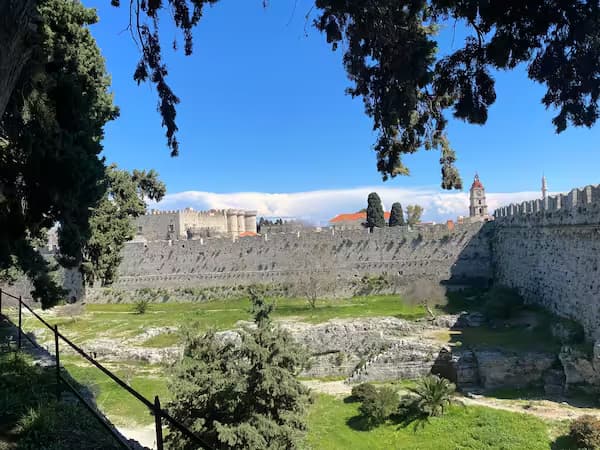
The Old Town of Rhodes is a UNESCO World Heritage Site enclosed by four kilometres of intact Crusader walls built by the Knights of St John in the 14th century. Cars are not permitted inside the walls. The most convenient paid car parks are near the D'Amboise Gate on the north side and the Koskinou Gate on the east — both are well signposted and within easy walking distance of the main sights. Rates are modest by European standards and most accept card payment. Once inside, allow at least three hours: walk the Street of the Knights (Ippoton), the most complete medieval street surviving in Europe; visit the restored Palace of the Grand Master; explore the bazaar quarter along Sokratous Street; and find the quieter Jewish Quarter around Martyron Evreon Square. Return in the evening when the walls are illuminated and the day-trippers have gone — the atmosphere is completely different after dark.
Best Rhodes Beaches Only Reachable by Car
The beaches that stay in your memory long after you leave are not the organised strips in front of the resort hotels. Anthony Quinn Bay — officially Vagies Beach — lies 20 kilometres south of the airport, a small rocky cove where the actor once bought land after filming The Guns of Navarone; the water is clear enough to see the sandy bottom at four metres. The adjacent Ladiko Bay is quieter still, accessed by a short coastal path. Tsambika Beach, 48 kilometres from Rhodes Town, is one of the longest stretches of fine sand on the island and is backed by a hilltop Byzantine monastery reached by 300 steps with panoramic views over the bay. Stegna, tucked behind Archangelos village, is a working fishing harbour with a sandy beach and tavernas serving whatever came off the boats that morning. Further south, Gennadi and Plimiri are largely empty even in August. None of these are served by regular public buses.
Driving the South of Rhodes: Prasonisi and the Empty Coast
Most package tourists turn around at Lindos. The 40 kilometres below it, down to the southern tip at Prasonisi, contains some of the most dramatic and least-visited coastline in the Greek islands. Prasonisi is a narrow sandy causeway connecting a rocky cape to the main island; the Aegean on one side and the Mediterranean on the other create a permanent wind channel that makes it one of the premier windsurfing and kitesurfing spots in Europe. The south-coast villages of Gennadi and Plimiri are quiet in the truest sense — fishing boats, stone tavernas, and almost no tourists even at peak season. Plan a full day for the southern loop: fill the tank in Lindos, pack water for the final stretch, and keep your eyes open for the unmarked tracks that lead down to completely empty coves.
No Deposit Car Rental in Rhodes
If you do not have a credit card or prefer not to have several hundred euros blocked on your account during your holiday, Karpadu's Premium Insurance option removes the deposit requirement entirely. You pay at pickup by cash, debit card, or prepaid card — nothing is held against your account. To find these vehicles quickly on the search results page, use the No Deposit filter: it shows only cars where the rental partner waives the excess hold under the Premium Insurance tier. Zero excess means zero deposit. No credit card is required at any stage during booking or collection.
Best Time to Rent a Car and Visit Rhodes
Rhodes receives around 300 days of sunshine a year, which means the island is driveable and enjoyable well outside the peak summer window. April and May are exceptional months to hire a car: wild flowers line the roadsides, car parks at Lindos and the Old Town are nearly empty, and you can drive the south coast road to Prasonisi without another tourist in sight. June and early July offer warm sea temperatures and fair rental prices with good availability. Late July and August are the busiest weeks — book your car at least three weeks in advance, arrive at Lindos before 09:30 to secure parking, and expect premium rates. September is widely considered the best month of all: the sea reaches its warmest temperature of 27 to 28 degrees, European schools return so crowds drop sharply, and rental prices fall noticeably compared to August peaks. October stays warm enough for swimming on most days, and the south coast will often be entirely yours.
Conclusion
Rhodes is large enough that no public transport network can show you the island properly. A rental car — collected at RHO Airport when you land and returned when you leave — is the most efficient and flexible way to see everything from the Lindos Acropolis and the medieval Old Town to the windsurfing bay at Prasonisi and the working fishing harbours of the south coast. Book early for the summer months, use the No Deposit filter if you want zero deposit, and head south along the east coast road as soon as you can. Rhodes rewards the curious driver at every turn.