
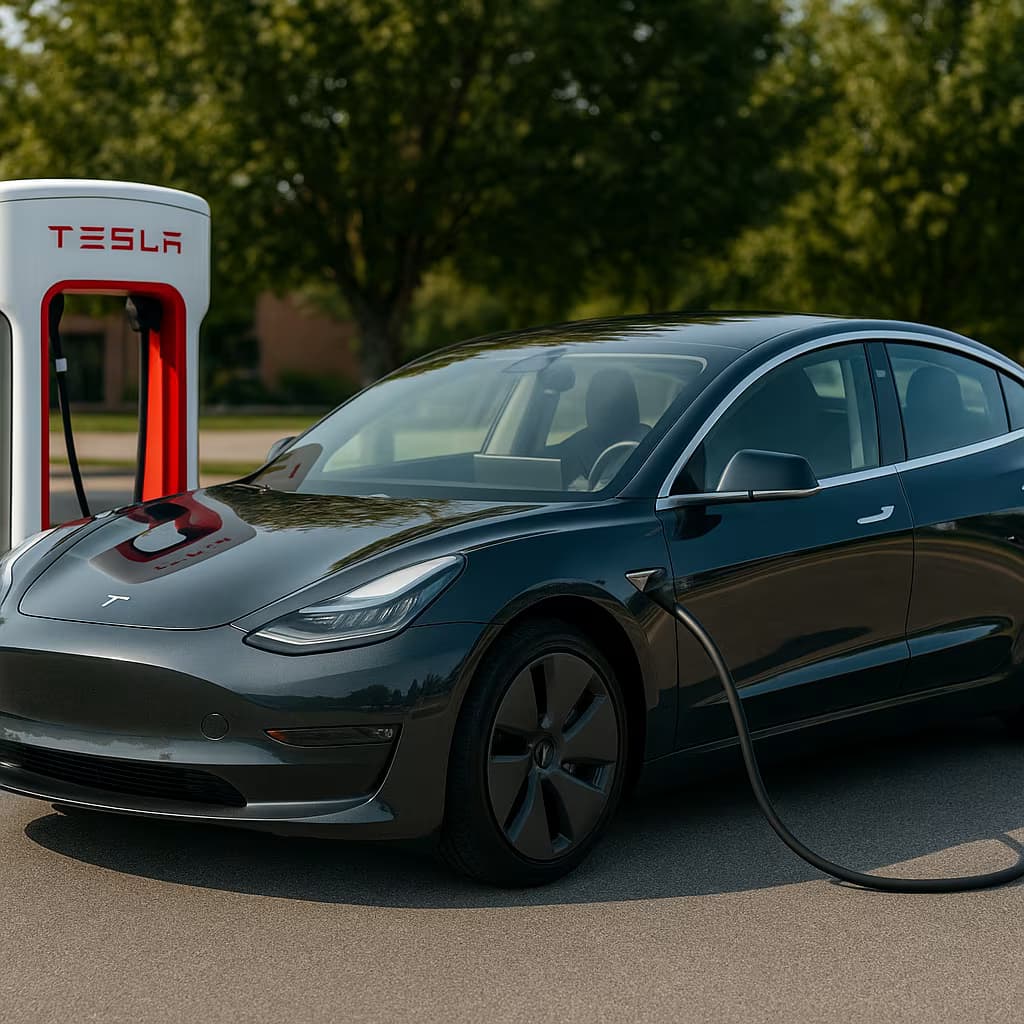
Electric car rental in Greece sounds ideal: silent driving through olive groves, no fuel stops on pristine island roads, and a smaller environmental footprint during your holiday. The reality is more nuanced. Greece has expanded its EV charging network since 2022, but coverage remains uneven across its islands, and summer conditions — extreme heat, heavy air-conditioning use, and tourist traffic — cut into the range that looks reassuring on paper. This guide gives you the honest picture for 2025: which islands support EV rentals well, where the gaps are, and when a petrol or hybrid car is simply the more practical choice for your trip.
Greece's EV Charging Network in 2025: The Real Picture
Greece operates a growing network of AC slow chargers (7–22 kW) and a smaller number of DC fast chargers (50–150 kW) across the mainland and major islands. On the mainland — Athens, Thessaloniki, the Peloponnese — infrastructure is reasonably dense along major roads and in city parking garages. On the islands, coverage is thinner and concentrated around port towns and resort hotels. The national HEDNO network and private operators like Volterra and Tera Energy have expanded installations, but rural areas on every island still have long gaps between chargers. Before booking an electric rental car in Greece, search the PlugShare or ChargeMap app for your specific island and planned route, not just the island name in general. A charger shown on the map may be at a private hotel not accessible to the public, may be out of service, or may have a queue of two or three vehicles ahead of you during peak season.
How Summer Heat Reduces Your Electric Range
The range figures advertised for electric rental cars in Greece are based on moderate-temperature WLTP testing cycles. In a Greek summer, two factors consistently reduce that range. First, air conditioning: in 35–38°C ambient temperatures, an EV's climate system draws 3–5 kW continuously to keep the cabin cool, which on a 40–50 kWh battery (typical for smaller EVs like the Fiat 500e or Peugeot e-208) represents 15–25% of total capacity consumed by cooling alone before the wheels turn. Second, battery thermal management: lithium-ion cells operate less efficiently above 35°C and may limit maximum charge rate to protect longevity, meaning the 30-minute fast charge you planned may take 45 minutes. In practical terms, a car rated at 250 km of range may deliver 180–200 km in July and August driving conditions. Plan your charging stops assuming 75–80% of the advertised range, add buffer time for potential charger queues, and never leave a charging stop at less than 30% remaining range on an island with sparse infrastructure.
Crete: The Most EV-Ready Greek Island
Crete is the best-equipped Greek island for electric car rental in 2025. The north coastal route — the VOAK highway from Heraklion (HER) west to Chania (CHQ) and east to Agios Nikolaos — has charging points at Heraklion city, Rethymno, and Chania, covering the 140 km stretch in manageable segments. Heraklion in particular has multiple public fast chargers in the city centre and near the port. The Knossos archaeological site (5 km from Heraklion) is within easy EV range for anyone staying in the city. The challenges begin when you leave the north coast: driving south toward Matala (75 km from Heraklion), Preveli Lagoon (47 km south of Rethymno), or the Sfakia coast involves significant altitude gain and loss that draws down battery faster than flat driving, and charger availability south of the VOAK is sparse. For an EV-based Crete trip, plan your itinerary around the north coast with VOAK charging, and treat the south as occasional excursions from a north-coast base where you can charge overnight.
Rhodes: Long Distances, Limited Chargers
Rhodes is 80 km long and has far fewer public chargers than Crete. The island's main tourist circuit — Rhodes Town to Lindos (50 km south, 55–65 minutes), Anthony Quinn Bay (20 km south), and Tsambika Beach (48 km) — is within the range of most electric cars on a single charge from a full battery. The problem is returning to a full charge at the end of the day. Public fast chargers in Rhodes are concentrated in Rhodes Town; Lindos and the southern part of the island have almost no public charging infrastructure as of 2025. If your Rhodes accommodation has a Type 2 socket or a dedicated EV charger, an overnight charge typically restores full range for the next day. If your hotel has no charging provision, you will need to return to Rhodes Town each evening or heavily limit your daily driving distance. For Rhodes itineraries that involve the full length of the island, a hybrid rental is more practical than a pure electric.
Santorini: Short Drives, Steep Hills
Santorini is 73 km² — no destination is more than 30 km from any other — which sounds ideal for electric driving. In practice, Santorini's caldera geography means constant steep climbs and descents that draw on battery more heavily than flat driving. The road from the port of Athinios up to Fira is 9 km of switchbacks gaining 220 metres of elevation; multiplied across a day of exploring Fira, Oia, Akrotiri, and Perissa, the cumulative altitude cycles add up. Santorini does have a small number of EV chargers near Fira and at some larger hotels, and the short distances mean range anxiety is not a serious concern even with heat penalties. The practical limitation is charger availability and waiting time during the busy July–August period when every tourist is trying to use the same infrastructure. An electric car works on Santorini if your accommodation has charging; if not, a small petrol car is simpler.
Mykonos: Small Island, Limited Infrastructure
Mykonos is 85 km² with some public EV chargers near Mykonos Town (Chora) and at a handful of larger resort hotels. The island's compact size means range is not a concern — a full battery in the morning covers a complete day of exploring all beaches and villages. The practical problem is parking, which is already Mykonos's biggest challenge in peak season, compounded if the only available charger in Chora has a queue. If you are staying at a hotel with private EV charging, Mykonos works well for an electric rental. If you are in a villa or smaller property with no charging, a small petrol car is more straightforward. The island's environmental sensitivity makes EV rentals an admirable choice in principle; the infrastructure just needs to catch up with the ambition.
Corfu, Zakynthos, and Kefalonia: Proceed Carefully
Corfu (Kerkyra) has a reasonable number of chargers concentrated in Corfu Town and a few hotel installations along the north coast. The island is 60 km long — a full north-to-south circuit is within range — but if you plan to explore the interior roads and both coasts in a single day, range planning is necessary. Zakynthos has very limited public charging infrastructure beyond Zakynthos Town itself; the minimum rental age on the island is also 21 with two years of driving experience, which limits the driver pool regardless of fuel type. Kefalonia, at 737 km², is the largest of the Ionian islands and has the most demanding road profile — the cliff roads toward Assos and the Myrtos descent — with limited charging outside Argostoli, the capital. For all three islands, check PlugShare for your specific travel dates before committing to an electric rental; infrastructure changes faster than any guide can track.
Athens and Thessaloniki: The Best EV Infrastructure in Greece
If you are renting an electric car in Athens or Thessaloniki, you are in the most EV-friendly part of Greece. Athens International Airport Eleftherios Venizelos (ATH) has several rental companies offering electric and hybrid vehicles, and the surrounding area — Kifissia, Glyfada, the southern suburbs — has dense public charging infrastructure compared to any Greek island. Athens city centre has fast chargers in major parking garages and at several shopping centres. For EV day trips from Athens, range and infrastructure work well: Cape Sounion (70 km south) and the Marathon coast are comfortable single-charge outings. Delphi (180 km north-west) is achievable with one charge stop en route. The E75 motorway between Athens and Thessaloniki (500 km) has charging stations at regular intervals — a realistic EV motorway drive for travellers combining both cities.
Thessaloniki's Macedonia Airport has EV rental options, and Thessaloniki itself has solid urban charging infrastructure — better than any Greek island and improving each year. The city's wide boulevards and organised parking areas make EV use more practical than in central Athens. For EV day trips from Thessaloniki: the Halkidiki Peninsula (70 km) is well within range for a full beach day and back; Mount Olympus and Litochoro (80 km) likewise. For travellers combining a mainland stay in Athens or Thessaloniki with an island leg, the island EV rental is typically a separate booking — though some Karpadu partners offer a Ferry Boarding Permission add-on that allows you to take your car across. Check the Personalise Your Ride section at checkout to see if your partner supports it.
Ferry Boarding Permission: Taking Your Rental Car Between Greek Islands
Taking a rental car on a Greek ferry between islands is not automatically permitted — but some Karpadu partner companies offer a Ferry Boarding Permission as a paid add-on. If your chosen partner supports it, you will see the option during checkout in the Personalise Your Ride section. You can add it before confirming the booking and the updated total is displayed before you pay — no commitment before you see the full cost. Partners that do not offer this permission require you to rent a fresh car on each island, picking up at the airport or port on arrival. For electric car rentals with Ferry Boarding Permission: the ferry crossing itself consumes no battery — you disembark with the same charge level you had when you boarded. Identify your first charging stop on the destination island before you arrive.
When a Hybrid or Petrol Car Makes More Sense in Greece
Electric rentals make sense on Crete (if staying on the north coast), Santorini (if your hotel has charging), and Mykonos (same condition). They are a more difficult choice on Rhodes, Kefalonia, Zakynthos, and Corfu if your accommodation has no private charging. In all cases where charging infrastructure is uncertain, a hybrid car — Toyota Yaris Hybrid, for example — offers the best of both worlds: fuel efficiency in town and resort driving (where the electric motor takes over at low speeds), and petrol backup for longer runs without charger anxiety. Hybrids also handle Greek summer heat without the same range-reduction penalty as pure EVs. If your priority is environmental responsibility and your accommodation has charging, book electric. If your priority is worry-free exploration across a full island, a hybrid or efficient petrol compact is the more honest recommendation.
Rising Petrol Prices and the Cost Case for Electric Rentals in Greece
The case for electric car rental in Greece has strengthened considerably as fuel costs rise. Greek petrol prices consistently rank among the highest in the EU — in 2025, unleaded petrol at island stations regularly reaches €1.90–2.20 per litre, with remote locations sometimes higher. For a week of driving in Crete covering 500–700 km, the fuel cost difference is significant: a petrol compact averaging 6 l/100 km costs €57–92 in fuel; the equivalent EV charged predominantly overnight at a hotel (at 0.20–0.35 €/kWh) costs €10–25 for the same distance. The weekly saving of €35–70 in fuel costs is real — enough to cover an extra dinner, a day excursion, or part of a ferry crossing. This cost advantage applies most clearly on Crete, where charging infrastructure makes EV rental most practical. On islands with limited public charging where you rely on hotel chargers, check whether your accommodation charges a premium for EV charging before assuming the full saving applies.
Electric Cars Are Silent: A Safety Note for Greek Village Streets
Electric vehicles are significantly quieter than petrol cars — below 30 km/h, an EV produces almost no engine noise. In Greece's village streets, narrow back lanes, and busy resort seafronts, this silence introduces a pedestrian safety consideration worth stating plainly. Greek road culture does not place strong emphasis on formal pedestrian safety education. Children playing near village streets, elderly residents who expect to hear a car coming, and visitors stepping off a taverna terrace are all accustomed to audible approaching vehicles. Zebra crossings in Greek towns are treated more as guidance than strict instruction — pedestrians do not always look both ways before stepping out, partly because they rely on hearing a car first. When driving an electric rental through a busy village, a tourist-heavy main street, or any narrow lane with pedestrians on both sides: drive at genuinely reduced speed and use your horn as a courteous advance signal — not aggressively, but as a friendly notice of your presence. The EV's silence is an asset on open coastal roads. In dense human spaces — especially anywhere children are present — it is a variable that requires active management.
How to Find and Book an Electric Car Rental in Greece
On the Karpadu search results page, electric and hybrid cars are listed alongside petrol vehicles and can be filtered by fuel type. Availability varies by island and season: Crete and Corfu have the most EV stock; smaller islands have fewer units. Electric rentals in Greece are subject to the same insurance options as petrol cars — including the No Deposit option with Premium Insurance, which comes with zero deposit and no credit card required. If you are planning a specific EV trip, check your hotel's charging availability before booking the car (many four- and five-star hotels now list EV charging as an amenity), and use PlugShare to map public chargers along your planned routes. Book your electric rental car 4–6 weeks in advance during July and August, when EV inventory — already limited on most Greek islands — sells out faster than standard petrol categories.
Conclusion
Electric car rental in Greece in 2025 is a real option and an increasingly financially smart one — with Greek island petrol at €1.90–2.20/litre, the weekly fuel saving of €35–70 versus a petrol car is genuine. Crete is the most EV-friendly island; Santorini and Mykonos work well if your hotel has charging. For Rhodes, Kefalonia, and Zakynthos, a hybrid is often the more practical compromise. Check charging infrastructure on PlugShare before booking, factor 20–25% range reduction for Greek summer heat, and never plan a route that leaves you with less than 30% charge in an area with sparse chargers. And remember the silence: drive slowly and use your horn as a courtesy signal through villages — Greek pedestrian habits assume they will hear you coming.